Overlay vs Full Rebuild: Two Approaches, Very Different Costs
The first decision in any staircase renovation is whether to overlay the existing structure or demolish and rebuild. An overlay keeps the existing concrete or steel staircase structure and adds new treads, risers, and railings on top. A full rebuild tears everything out and constructs a new staircase from scratch.
Overlays cost $8,000 to $25,000 depending on materials and railing choice. Full rebuilds run $25,000 to $60,000 or more, as they involve structural demolition, temporary support, new structural elements, and potentially engineering approvals. Most staircase renovations are overlays — the existing structure is typically sound and only the finishes need updating.
Before committing to either approach, have the existing staircase inspected. Concrete stairs in good condition with no cracking or spalling are ideal overlay candidates. Stairs with structural issues, inadequate dimensions (too narrow, wrong rise/run ratio), or in conservation homes needing redesign may require a full rebuild.
Material Costs: Treads and Risers
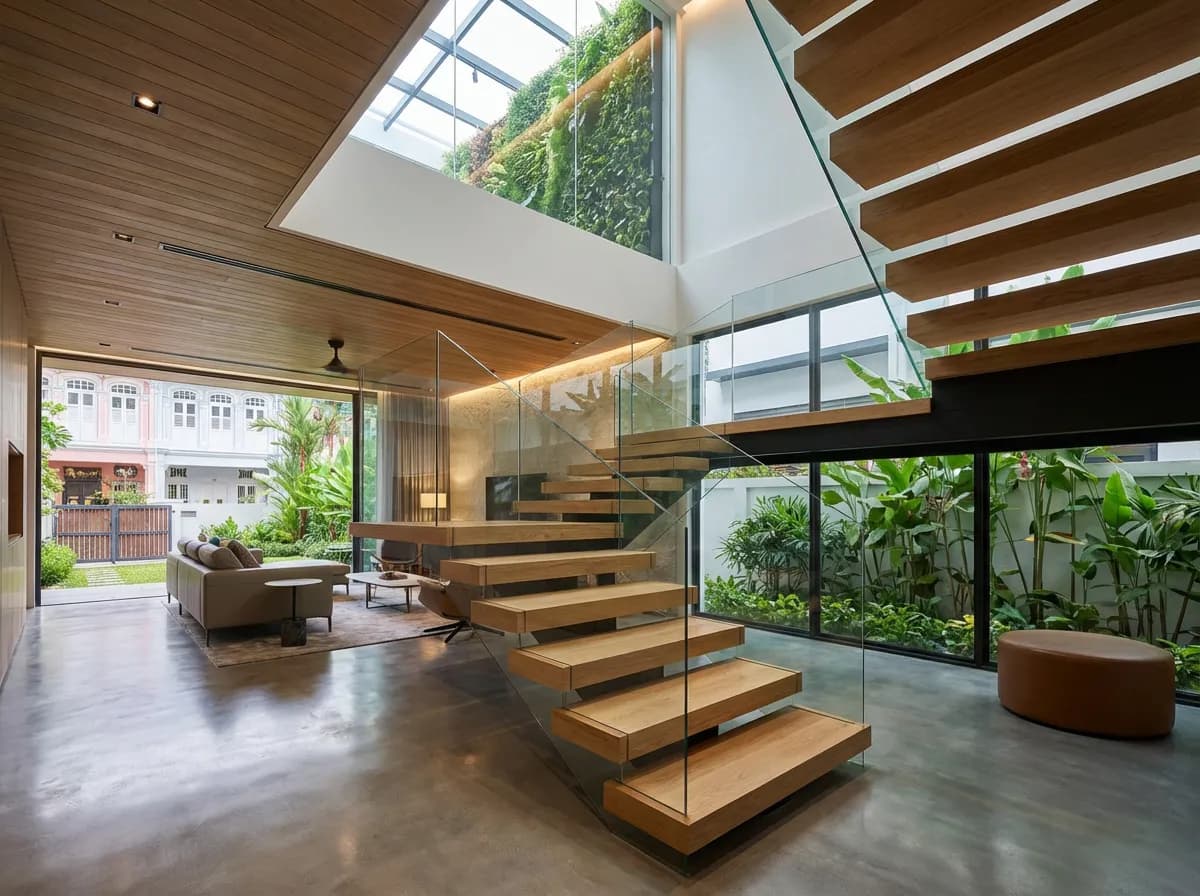
Timber overlay is the most popular choice. Solid teak treads and risers cost $250 to $400 per step (material only). European oak runs $200 to $350 per step. American walnut is $280 to $420 per step. Engineered timber (a timber veneer over plywood) costs 30 to 40% less but won't last as long under heavy foot traffic. For a typical 14-step staircase, timber tread materials alone cost $3,000 to $6,000.
Natural stone is more expensive. Marble treads cost $300 to $600 per step depending on the marble variety — Carrara is at the lower end, Calacatta at the premium end. Granite is $200 to $400 per step and is more durable than marble. Terrazzo (poured or tiles) runs $250 to $500 per step. A 14-step stone staircase costs $4,000 to $8,500 in materials.
Homogeneous tiles ($50 to $150 per step) and vinyl overlays ($30 to $80 per step) are budget options. They're functional and can look decent, but they lack the visual impact and durability of solid timber or stone.
Railing and Balustrade Costs
Railing costs often surprise homeowners — they can equal or exceed the tread costs. A basic powder-coated mild steel railing with vertical balusters costs $2,000 to $4,000 for a full staircase. Stainless steel (grade 304) railings run $3,500 to $7,000. Glass balustrades with stainless steel handrails are $5,000 to $12,000.
Timber railings and balusters cost $3,000 to $8,000, depending on the timber species and design complexity. Wrought iron with decorative scrollwork — popular in more traditional homes — runs $3,500 to $9,000. Cable railings (stainless steel cables between posts) offer a modern, open look for $4,000 to $8,000.
If your existing railing is structurally sound and the style isn't dated, refinishing it (sanding, repainting, or powder-coating) costs just $500 to $1,500 — a significant saving over full replacement.
Labour and Installation Costs
Labour for a staircase overlay typically runs $3,000 to $8,000, covering demolition of existing finishes, surface preparation, tread and riser installation, railing installation, and finishing. The timeline is 1 to 3 weeks depending on complexity.
Full rebuild labour is substantially higher: $8,000 to $20,000 for demolition, temporary works, structural installation, and finishing. A rebuild typically takes 3 to 6 weeks and may require a structural engineer's involvement ($2,000 to $5,000 for design and supervision).
Specialised work — curved staircase carpentry, complex glass balustrade installation, or custom metalwork — commands premium rates. Budget 20 to 30% above standard labour rates for these skills.
Hidden Costs Most Homeowners Miss
Floor level transitions: when you change tread thickness (e.g., from tiles to timber), the floor level at the top and bottom of the stairs changes slightly. Adjusting adjacent flooring to match can cost $500 to $2,000. This is easy to overlook during planning but very visible in the finished result.
Lighting integration: many homeowners add step lighting, cove lighting under the nosing, or pendant lights in the stairwell during renovation. Electrical works and fixtures add $1,000 to $4,000 depending on complexity. Plan this before the treads go in — retrofitting lighting after installation is messy and expensive.
Protection and making good: your staircase connects every floor, so renovation debris, dust, and traffic affect the whole house. Proper floor protection, dust barriers, and post-renovation deep cleaning add $500 to $1,500. And making good to adjacent walls, flooring, and paintwork after railing removal and installation typically costs another $500 to $1,000.
Cost-Saving Tips
Mix materials strategically: solid timber treads with painted MDF risers save 20 to 30% on material costs without sacrificing the look, since risers are the vertical surfaces that receive less visual attention and no foot traffic.
Keep the existing railing if it's structurally sound. A fresh powder-coat finish in a contemporary colour can transform dated aluminium or steel railings for a fraction of replacement cost. Reuse the existing nosing profile if switching from tile to timber — custom nosing profiles are expensive to mill.
Bundle your staircase renovation with other works happening in the house. Contractors offer better rates when there's a larger project scope, and you save on mobilisation costs and site setup. At DirectHome, we routinely coordinate staircase renovation with railing, lighting, and adjacent flooring works to deliver a cohesive result at better value.
Related Services
Need Help With Your Project?
Get a free site assessment and no-obligation quote.